Whisky is one of the most rewarding subjects in commercial photography, and one of the most unforgiving. Get it right and there's a warmth and depth to the image that feels almost tangible — you can practically smell it. Get it wrong and it looks like a bottle of flat cola sitting on a table.
The approach we take always begins with the spirit itself. What colour is it? How does light move through it? Is it a pale, delicate single malt or a deep, heavily sherried dram? A young grain whisky and a 30-year-old Speyside will demand completely different setups, and treating them the same is the first mistake.

Rare Find Old Rhosdu 30yo — deep colour, complex character, demanding setup.
Why we use strobe
For spirits work we almost always shoot with strobe flash rather than continuous lighting. The control it gives you is simply unmatched. You can shape the light precisely, freeze a pour mid-air with complete sharpness, and repeat the same setup shot after shot with total consistency. When a client needs a suite of images that all feel cohesive — same light quality, same depth — strobe is how you deliver that reliably.
Continuous light has its place, and there are moments where a warmer, more ambient feel suits the brief — a moody lifestyle shot, a cocktail in a candlelit bar. But for the product itself, for the bottle and the liquid, strobe gives us the precision the work demands.
Every spirit has its own character, and the lighting has to start there — not with a preset, not with a formula, but with the bottle itself.
The real challenge: reflections
If there's one thing that separates a mediocre spirits shot from a genuinely great one, it's the handling of reflections. Glass is a nightmare — it picks up everything in the room, every softbox edge, every stray highlight, the camera itself if you're not careful. Managing what appears in that glass, and what doesn't, is where most of the real work happens.
We use a combination of flags, diffusion panels, and careful positioning to control what the bottle sees. Sometimes we want a clean, even gradient across the glass — no hard edges, no hotspots. Other times a single sharp highlight running down the side of a bottle is exactly what gives it presence. The decisions are all deliberate, and they all take time.
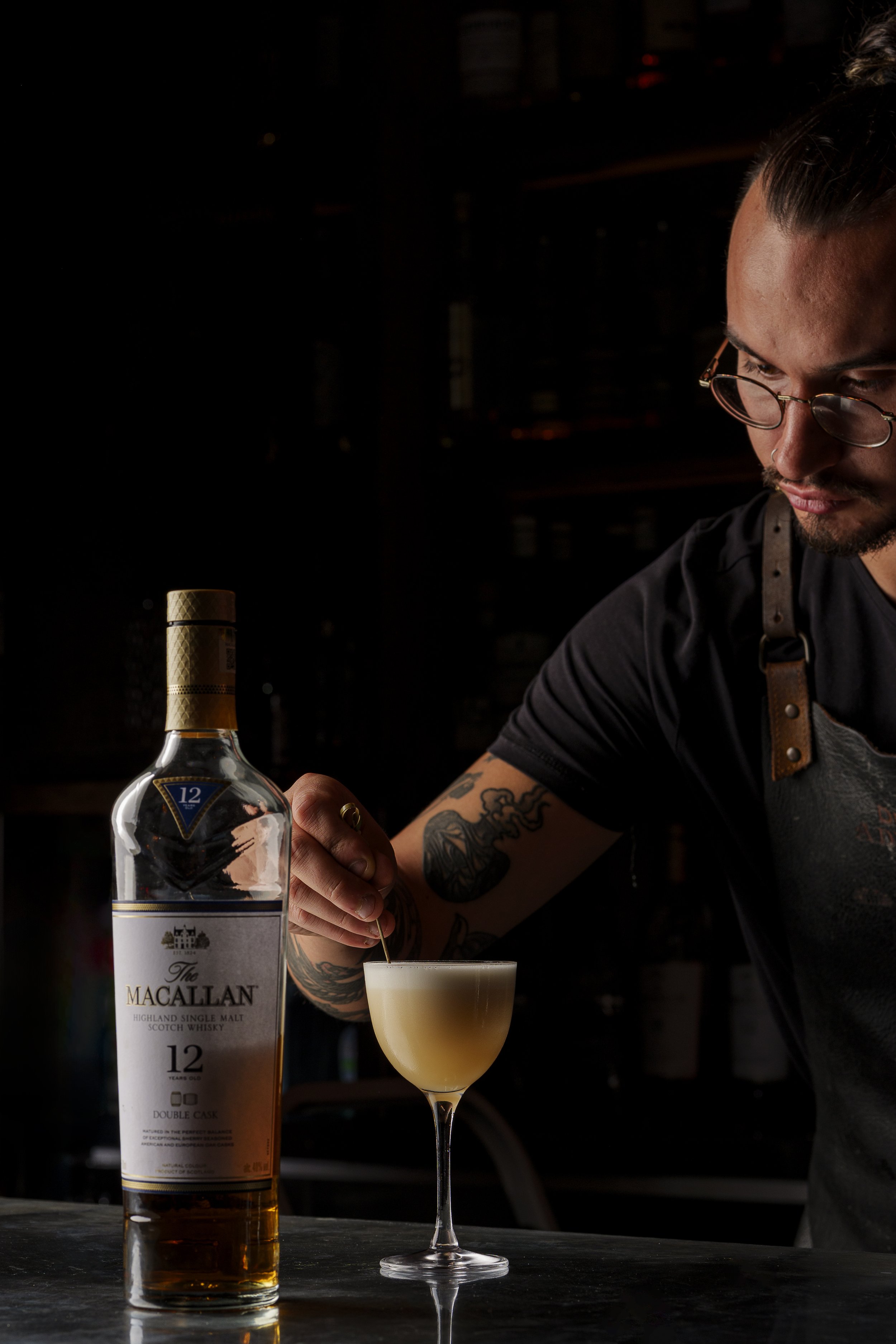

The pour itself is a separate challenge again. Catching whisky mid-pour — that arc of amber liquid in the air — requires a fast flash duration to freeze the movement cleanly. Too slow and you get blur where you want clarity. It usually takes more attempts than clients expect, and we're always honest about that upfront. The shot that looks effortless in the final edit very rarely was.
Reading the spirit
What we've found over years of spirits work is that the best results come from slowing down at the start. Spend time with the bottle before you fire a single shot. Hold it up to the light. Think about what makes this particular whisky interesting — its age, its provenance, the colour the cask has given it — and let that guide every decision that follows. The lighting is in service of the story. It always is.